


As it is known that anxiety disorders like social phobia and conduct disorder OCD (obsessive Compulsive Disorder), is more common in people with anorexia than in general population.
This anxiety disorders usually appear sooner than eating disorders. The research of Dr. Cynthia M Bulik of the University of North Carolina at Chapel Hill with his colleagues trying to find out whether excessive if the history of anxiety disorders (overanxious disorder) in childhood associated with a number of cases of anorexia in women.
The result, found that of 637 women with anorexia, approximately 39% of them have symptoms of excessive anxiety disorders in childhood. In addition, in almost all cases, the symptoms of anorexia anxiety arises before the attack. Results of recent studies are then published in the International Journal of Eating Disorders.
In general, the researchers also found that women with a history of anxiety disorders in childhood show some personality or behavior that tends to "extreme", suppose the nature of perfectionism and obsessive disorders associated with food.
They also tend to accidentally "cleaned up" by vomiting or taking laxatives in order to limit food intake. Bulik and colleagues argue, when the childhood anxiety disorders into a kind of "gateway" into anorexia.
Thus, this confirms the importance of awareness and early treatment of this condition. Anorexia is an eating disorder. The patient was willing to hunger (hunger) to get the skinny body.
Not surprisingly, this case experienced by most young women who experience excessive anxiety will become fat. Therefore, a diet that is too tight. As a result, she can up in the hospital or even die.
Not just about anorexia, anxiety during the golden times of childhood would interfere with the development of their personality and have implications to how to perceive and adapt to this life. Children should we save not only because of fears they could trigger anorexia but also because of anxiety capable of forming a children's anger towards the wrong ways either as an individual or within the scope of bersosial life
Read Here : Physical and Psychological Symptoms of Anorexia Nervosa

Professor Christopher Gillberg of the National Centre of Autism Studies believed characteristic of autism in girls and young women become lost because they could not be more obvious than in men.
He said: "Counting calories may be a manifestation of the disease of autism, and is very important to take this amount when he decided to do therapy."
Disorders of the brain characterized by a difficulty in communication and social interaction.
Professor Gillberg, which is based at Strathclyde University, also said: "I have seen numerous cases where the disease anorexia has become completely entrenched because people do not know the underlying eating disorder is the disease of autism."
Such conditions are often seen besarpada influential men, but it seems many young women are not easily diagnosed.
"You might have a daughter who spoke with inexhaustible and does not listen, and they were classified as 'bubbly'. In addition, they mingled with it, but maybe they have autistic spectrum of elements."
Boy with autism often show signs of disease-tandasecara clear and narrow the number of subjects. While female patients were more likely such as 'collection' of people, remembering the name may be ketertarikanistimewa, thus firmly Prof Gillberg.
In addition, men in general are more likely to show a hyper-active. This adds to their chance to take to a specialist, who then might be able to see signs of autism disease.
I think as a mom that have a daughter, we should give more attention about this report because the early treatment will give the best result. I have some friends have some daughters with similiar symptoms like autism and anorexia nervosa.
Read here : Physical and Psychological Symptoms of Anorexia Nervosa
Anorexia Nervosa , nowadays have more and more suffers. Life complexity , wrong mindset about beauty and body , wrong mindset about exercise and food intake make more new suffers day by day. Anorexia Nervosa suffers is easily find in our community mostly easier look from their habit and performance. The description of this post ( Physical and Psychological Anorexia Nervosa Symptoms ) is the best way to recognize them , plus some of them also have problems with Acne ( Acne in Anorexia Nervosa ).
To complete our knowledge about Anorexia Nervosa , here are some books good for reading about it.
This book is for people who want to understand and recover from anorexia nervosa. Both of the authors of this book have fully recovered from eating disorders, and many individuals who have recovered or are recovering from anorexia also contributed insights and suggestions.* Whether you yourself are suffering with anorexia or you know someone who is, their wisdom can inspire and guide you.
As you will read in Chapter 2, Monika Ostroff battled with anorexia for many years. She shares her story of self-starvation, years of unsuccessful treatment, and eventual breakthroughs that led to her complete recovery. Her ideas about the nature of anorexia and what it takes to defeat obsessive food behaviors and thoughts encompass much of the text. She writes with understanding and compassion; and, when she recommends that you try something, it is because it has worked for her. . .
Or this book
This practical manual offers a step-by-step guide to the treatment of anorexia nervosa in adolescents. Unique in its focus on mobilizing parents and siblings as a resource in treatment, the approach is ideal for short-term treatment and has demonstrated effectiveness in controlled clinical trials. Intervention is divided into three clearly defined phases. Using such innovative methods as a family meal, the clinician first learns strategies for helping families gain immediate control over the adolescent's eating behaviors. Once the patient accepts parental demands to eat, related family problems are addressed in the second phase. The third and final phase of treatment aims toward getting adolescent development back on track and establishing family relationships that do not revolve around the eating disorder. Featuring detailed guidelines for conducting each family session, the manual is illustrated with extensive clinical transcripts and vignettes.
I hope, these Anorexia Nervosa books are the best for you!!
To complete our knowledge about Anorexia Nervosa , here are some books good for reading about it.
This book is for people who want to understand and recover from anorexia nervosa. Both of the authors of this book have fully recovered from eating disorders, and many individuals who have recovered or are recovering from anorexia also contributed insights and suggestions.* Whether you yourself are suffering with anorexia or you know someone who is, their wisdom can inspire and guide you.
As you will read in Chapter 2, Monika Ostroff battled with anorexia for many years. She shares her story of self-starvation, years of unsuccessful treatment, and eventual breakthroughs that led to her complete recovery. Her ideas about the nature of anorexia and what it takes to defeat obsessive food behaviors and thoughts encompass much of the text. She writes with understanding and compassion; and, when she recommends that you try something, it is because it has worked for her. . .
Or this book
This practical manual offers a step-by-step guide to the treatment of anorexia nervosa in adolescents. Unique in its focus on mobilizing parents and siblings as a resource in treatment, the approach is ideal for short-term treatment and has demonstrated effectiveness in controlled clinical trials. Intervention is divided into three clearly defined phases. Using such innovative methods as a family meal, the clinician first learns strategies for helping families gain immediate control over the adolescent's eating behaviors. Once the patient accepts parental demands to eat, related family problems are addressed in the second phase. The third and final phase of treatment aims toward getting adolescent development back on track and establishing family relationships that do not revolve around the eating disorder. Featuring detailed guidelines for conducting each family session, the manual is illustrated with extensive clinical transcripts and vignettes.
I hope, these Anorexia Nervosa books are the best for you!!
Anorexia nervosa is complex eating disorder ( Read here for: Physical and.Psychologically Anorexia Symptoms ) , was first established by Sir William Gull in his speech at to the British Medical Association at Oxford in1873. He said about a peculiar form of disease occurring mostly in young women, and characterised by extreme emaciation. Gull observed that the cause of the condition could not be determined, but that cases seemed mainly to occur in young women between the ages of sixteen and twenty-three. In this address, Gull referred to the condition as Apepsia hysterica, but subsequently amended this to Anorexia hysterica and then to Anorexia nervosa.
Five years later, in 1873, Gull published his seminal work “Anorexia Nervosa (Apepsia Hysterica, Anorexia Hysterica)", in which he describes the three cases of Miss A, Miss B, and a third unnamed case. In 1887, he also recorded the case of Miss K, in what was to be the last of his medical papers to be published.
Miss A was referred to Sir William Gull by her doctor, a Mr Kelson Wright, of Clapham, London on 17th January 1866. She was aged 17 and was greatly emaciated, having lost 33 pounds. Her weight at this time was 5 stones 12 pounds (82 pounds); her height was 5 ft 5 inches. Gull records that she had suffered from amenorrhoea for nearly a year, but that otherwise her physical condition was mostly normal, with healthy respiration and heart sounds and pulse; no vomiting nor diarrhoea; clean tongue and normal urine. The pulse was slightly low at between 56 and 60. The condition was that of simple starvation, with total refusal of animal food and almost total refusal of everything else.
Gull prescribed various remedies (including preparations of cinchona, biochloride of mercury, syrup of iodide of iron, syrup of phosphate of iron, citrate of quinine) and variations in diet without noticeable success. He noted occasional voracious appetite for very brief periods, but states that these were very rare and exceptional. He also records that she was frequently restless and active and notes that this was a "striking expression of the nervous state, for it seemed hardly possible that a body so wasted could undergo the exercise which seemed agreeable".
In Gull's published medical papers, images of Miss A are shown that depict her appearance before and after treatment (right). Gull notes her aged appearance at age 17:
It will be noticeable that as she recovered she had a much younger look, corresponding indeed to her age, twenty-one; whilst the photographs, taken when she was seventeen, give her the appearance of being nearer thirty.
Miss A remained under Gull's observation from January 1866 to March 1868, by which time she seemed to have made a full recovery, having gained in weight from 82 to 128 pounds.
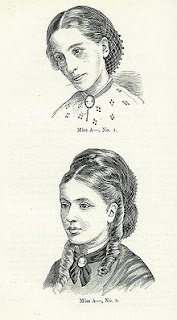
Miss B, pictured around 1868 aged 18 (No. 1) and 1872 (No. 2). From the published medical papers of Gull
 Miss B was the second case described in detail by Gull in his Anorexia nervosa paper. She was referred to Gull on 8th October 1868, aged 18, by her family who suspected tuberculosis and wished to take her to the south of Europe for the coming winter.
Gull noted that her emaciated appearance was more extreme than normally occurs in tubercular cases. His physical examination of her chest and abdomen discovered nothing abnormal, other than a low pulse of 50, but he recorded a "peculiar restlessness" that was difficult to control. The mother advised that "She is never tired". Gull was struck by the similarity of the case to that of Miss A, even to the detail of the pulse and respiration observations.
Miss B was treated by Gull until 1872, by which time a noticeable recovery was underway and eventually complete. Gull admits in his medical papers that the medical treatment probably did not contribute much to the recovery, consisting, as in the former case, of various tonics and a nourishing diet.
Miss K was brought to Gull's attention by a Dr. Leachman, of Petersfield, in 1887. He notes the details in the last of his medical papers to be published.[24] Miss K was aged 14 years in 1887. She was the third child in a family of six, one of whom died in infancy. Her father had died, aged 68, of pneumonic phthisis. Her mother was living and in good health; she had a sister who displayed various nervous symptoms and an eplieptic nephew. With these exceptions, no other neurotic cases were recorded in the family. Miss K, who was described as a plump, healthy girl until the beginning of 1887, began to refuse all food except half cups of tea or coffee in February that year. She was referred to Gull and began to visit him of 20 April 1887; in his notes, he remarks that she persisted in walking through the streets to his house despite being an object of attention to passers-by. He records that she displayed no sign of organic disease; her respiration was 12 to 14; her pulse was 46; and her temperature was 97º. Her urine was normal. Her weight was 4 stone 7 pounds (63 pounds) and her height was 5 feet 4 inches. Miss K expressed herself to Gull as "quite well". Gull arranged for a nurse from Guy's to supervise her diet, ordering light food every few hours. After six weeks, Dr. Leachman reported good progress and by 27 July her mother reported that her recovery was almost complete, with the nurse by this time no longer being needed.
Photographs of Miss K appear in Gull's published papers. The first is dated 21 April 1887 and shows the subject in a state of extreme emaciation. The unclothed torso and head is displayed with the ribcage and clavicle clearly visible. The second photograph is dated 14 June 1887 in a similar attitude and shows a clear recovery.
Although the cases of Miss A, Miss B and Miss K resulted in recovery, Gull states that he observed at least one fatality as a result of anorexia nervosa. He states that the post mortem revealed no physical abnormalities other than thrombosis of the femoral veins. Death appeared to have resulted from starvation alone.
Gull observed that slow pulse and respiration seemed to be common factors in all the cases he had observed. He also observed that this resulted in below-normal body temperature and proposed the application of external heat as a possible treatment. This proposal is still debated by scientists today.
Gull also recommended that food should be administered at intervals varying inversely with the periods of exhaustion and emaciation. He believed that the inclination of the patient should in no way be consulted; and that the tendency of the medical attendant indulge the patient ("Let her do as she likes. Don't force food"), particularly in the early stages of the condition, was dangerous and should be discouraged. Gull states that he formed this opinion after experience of dealing with cases of anoerexia nervosa, having previously himself been inclined to indulge patients' wishes.( wikipedia ).
Read here : Acne in Anorexia Nervosa
Five years later, in 1873, Gull published his seminal work “Anorexia Nervosa (Apepsia Hysterica, Anorexia Hysterica)", in which he describes the three cases of Miss A, Miss B, and a third unnamed case. In 1887, he also recorded the case of Miss K, in what was to be the last of his medical papers to be published.

Miss A was referred to Sir William Gull by her doctor, a Mr Kelson Wright, of Clapham, London on 17th January 1866. She was aged 17 and was greatly emaciated, having lost 33 pounds. Her weight at this time was 5 stones 12 pounds (82 pounds); her height was 5 ft 5 inches. Gull records that she had suffered from amenorrhoea for nearly a year, but that otherwise her physical condition was mostly normal, with healthy respiration and heart sounds and pulse; no vomiting nor diarrhoea; clean tongue and normal urine. The pulse was slightly low at between 56 and 60. The condition was that of simple starvation, with total refusal of animal food and almost total refusal of everything else.
Gull prescribed various remedies (including preparations of cinchona, biochloride of mercury, syrup of iodide of iron, syrup of phosphate of iron, citrate of quinine) and variations in diet without noticeable success. He noted occasional voracious appetite for very brief periods, but states that these were very rare and exceptional. He also records that she was frequently restless and active and notes that this was a "striking expression of the nervous state, for it seemed hardly possible that a body so wasted could undergo the exercise which seemed agreeable".
In Gull's published medical papers, images of Miss A are shown that depict her appearance before and after treatment (right). Gull notes her aged appearance at age 17:
It will be noticeable that as she recovered she had a much younger look, corresponding indeed to her age, twenty-one; whilst the photographs, taken when she was seventeen, give her the appearance of being nearer thirty.
Miss A remained under Gull's observation from January 1866 to March 1868, by which time she seemed to have made a full recovery, having gained in weight from 82 to 128 pounds.
Miss B, pictured around 1868 aged 18 (No. 1) and 1872 (No. 2). From the published medical papers of Gull

Gull noted that her emaciated appearance was more extreme than normally occurs in tubercular cases. His physical examination of her chest and abdomen discovered nothing abnormal, other than a low pulse of 50, but he recorded a "peculiar restlessness" that was difficult to control. The mother advised that "She is never tired". Gull was struck by the similarity of the case to that of Miss A, even to the detail of the pulse and respiration observations.
Miss B was treated by Gull until 1872, by which time a noticeable recovery was underway and eventually complete. Gull admits in his medical papers that the medical treatment probably did not contribute much to the recovery, consisting, as in the former case, of various tonics and a nourishing diet.
Miss K was brought to Gull's attention by a Dr. Leachman, of Petersfield, in 1887. He notes the details in the last of his medical papers to be published.[24] Miss K was aged 14 years in 1887. She was the third child in a family of six, one of whom died in infancy. Her father had died, aged 68, of pneumonic phthisis. Her mother was living and in good health; she had a sister who displayed various nervous symptoms and an eplieptic nephew. With these exceptions, no other neurotic cases were recorded in the family. Miss K, who was described as a plump, healthy girl until the beginning of 1887, began to refuse all food except half cups of tea or coffee in February that year. She was referred to Gull and began to visit him of 20 April 1887; in his notes, he remarks that she persisted in walking through the streets to his house despite being an object of attention to passers-by. He records that she displayed no sign of organic disease; her respiration was 12 to 14; her pulse was 46; and her temperature was 97º. Her urine was normal. Her weight was 4 stone 7 pounds (63 pounds) and her height was 5 feet 4 inches. Miss K expressed herself to Gull as "quite well". Gull arranged for a nurse from Guy's to supervise her diet, ordering light food every few hours. After six weeks, Dr. Leachman reported good progress and by 27 July her mother reported that her recovery was almost complete, with the nurse by this time no longer being needed.
Photographs of Miss K appear in Gull's published papers. The first is dated 21 April 1887 and shows the subject in a state of extreme emaciation. The unclothed torso and head is displayed with the ribcage and clavicle clearly visible. The second photograph is dated 14 June 1887 in a similar attitude and shows a clear recovery.
Although the cases of Miss A, Miss B and Miss K resulted in recovery, Gull states that he observed at least one fatality as a result of anorexia nervosa. He states that the post mortem revealed no physical abnormalities other than thrombosis of the femoral veins. Death appeared to have resulted from starvation alone.
Gull observed that slow pulse and respiration seemed to be common factors in all the cases he had observed. He also observed that this resulted in below-normal body temperature and proposed the application of external heat as a possible treatment. This proposal is still debated by scientists today.
Gull also recommended that food should be administered at intervals varying inversely with the periods of exhaustion and emaciation. He believed that the inclination of the patient should in no way be consulted; and that the tendency of the medical attendant indulge the patient ("Let her do as she likes. Don't force food"), particularly in the early stages of the condition, was dangerous and should be discouraged. Gull states that he formed this opinion after experience of dealing with cases of anoerexia nervosa, having previously himself been inclined to indulge patients' wishes.( wikipedia ).
Read here : Acne in Anorexia Nervosa

Not only Acne in Anorexia Nervosa but there are also another bad reactions body by stopping some processes such as drastically reducing blood pressure, breathing weaken, the woman stops menstruating (or in children with an adult, probably stopped menstruating (or in children with an adult, probably not started menstruating at all), and thyroid gland that regulates the growth disappeared. The skin dries Hair and nails become brittle. Other symptoms that may arise is a headache, chills, constipation, and swelling of the joints. The lack of fat causes the body temperature decreases. As a natural mechanism, a growth lanugo or hair all over the body including the face. In addition, the imbalance of chemicals in body can also cause heart attacks.
Acne in Anorexia Nervosa is like a chain reaction of anorexia nervosa as one of Dermatologic Signs of Anorexia Nervosa so it need completely healing for it not just the acne. They need heal their Anorexia Nervosa problems first then the acne because the Acne in Anorexia Nervosa just an effect.
To know more about Anorexia Nervosa , physically and psychologically the Anorexia Nervosa Symptom you can read this articles : Physically and Psychologically the Anorexia Nervosa Symptom
But if you want to know more about Acne in Anorexia Nervosa , you can read in this articles:
• What is The Acne and The Treatment ?
• How To Get Rid of Stubborn Acne?
• How Many Type of Acne are There ?
• Coconut Oil For Acne Treatment
• Type of Acne Scars
• Acne Treatments
• The Causes of Acne