


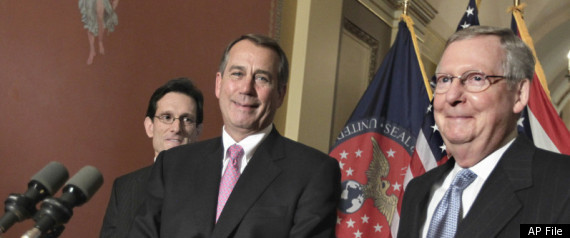
 House Republicans dealt defeat to their own proposal for a $2.4 trillion increase in the nation's debt limit Tuesday, a political gambit designed to reinforce a demand for spending cuts to accompany any increase in government borrowing.
 The vote was lopsided, with just 97 in favor of the measure and 318 against.
House Democrats accused the GOP of political demagoguery, while the Obama administration maneuvered to avoid taking sides – or giving offense to majority Republicans.
The debate was brief, occasionally impassioned and set a standard of sorts for public theater, particularly at a time when private negotiations continue among the administration and key lawmakers on the deficit cuts Republicans have demanded.
The bill "will and must fail," said Rep. Dave Camp, R-Mich., the House Ways and Means Committee chairman who noted he had helped write the very measure he was criticizing.
"I consider defeating an unconditional increase to be a success, because it sends a clear and critical message that the Congress has finally recognized we must immediately begin to rein in America's affection for deficit spending," he said. (read more)
 ABC News' Huma Khan reports: Congress is under pressure to cut the rapidly rising costs of the federal government’s food stamps program at a time when a record number of Americans are relying on it.
 The House Appropriations Committee today will review the fiscal year 2012 appropriations bill for the Department of Agriculture that includes $71 billion for the agency’s “Supplemental Nutrition Assistance Program.” That’s $2 billion less than what President Obama requested but a 9 percent increase from 2011, which, critics say, is too large given the sizeable budget deficit.
A record number of Americans -- about 14 percent -- now rely on the federal government’s food stamps program and its rapid expansion in recent years has become a politically explosive topic.
More than 44.5 million Americans received SNAP benefits in March, an 11 percent increase from one year ago and nearly 61 percent higher than the same time four years ago.
Nearly 21 million households are reliant on food stamps. (read more)
 Libya thought it was placing a sure bet when it gave $1.3 billion to Goldman Sachs to invest in currencies and other trades, according to The Wall Street Journal.
 What it got: a 98 percent loss, followed by an offer of a huge chunk of Goldman shares.
The newspaper reports that Goldman offered Libyan officials several options for earning back the country's money -- including taking a piece of the global financial firm -- after Goldman lost its investments in bank trades and currency baskets.
The talks eventually amounted to naught, the newspaper reports, and nothing was done about the massive losses in 2008, right as the global economy took a fierce slide. (read more)
America's various Debt and Deficit Commissions, 2012 Executive and Congressional Budget Proposals all sustain a $24 Trillion U.S. National Debt in the year 2021, despite proposed austerity measures.Carrying a 4% interest rate, this principal would require a $960 billion debt interest payment. This is the brain trust resolution, consensus, after the expenditure of trillions of taxpayer dollars for bailouts, stimulus packages, warehousing of toxic assets --- derivatives, credit default swaps, bad mortgages, quantitative easing 1 & 2 --- and annual Federal government operating deficits in excess of $1 trillion. Meanwhile, the budget is to be balanced on the backs of America's middle and working classes, elderly, children, and the poor. Obviously, the country is mired in low expectations, instead of launching a complete breakout from the encirclement of past, present, and future liabilities.
Obama Memo#8 presents not just a $32 Trillion breakout but a complete reversal of the nation's fortune. It is on the overlooked real asset side of America's balance sheet that the mastery of our affairs lies. Specifically, the monetization or securitization of 8,133 tons of U.S. gold, without a gold standard, and of 700 million acres of public land with mineral estate.
Obama Memo#8
May 2, 2011
To: President Barack Obama
From: Sioan Stephen Bethel
Subject: A $32 Trillion Proposition
America’s real assets, 8133 ton gold reserve and 700 million acres of public land [with mineral estate], have largely been ignored in addressing the nation’s financial and economic problem. The monetization or securitization of gold, without a gold standard, and of public land, affords 32 trillion inconvertible gold and public land notes, kept separate and apart from Federal Reserve Notes in general circulation. Though these notes are irredeemable, for gold or public land, they are convertible, debt free, and at a premium, to Federal Reserve notes. This money, in turn, would be utilized to amortize or repurchase any portion of the U.S. National Debt. In the case of repurchase, debt interest payments become disposable income, abetting tax reduction and any other fiscal policies. The introduction of $32 trillion, today, positively alters the vector of inter-generational economics, particularly offsetting or preempting the growth of unfunded liabilities. Note, this asset-based intervention requires no borrowing or additional taxation; therefore perfectly suited to the temperament of the American body politic.
History
Gold
There are plenty of arguments against the re-instatement of an American gold standard. Some are proffered by the Chairman of the Federal Reserve Bank, Bernard Bernanke.
"It did deliver price stability over long periods of time, but over shorter periods of time it caused wide swings in prices related to changes in demand or supply of gold," he told the Senate Banking Committee. "So I don't think it's a panacea." Bernanke also said that gold couldn't return as the world standard because there's not enough gold in the world to effectively support the U.S. money supply.
Federal Reserve Chairman Ben Bernanke dismissing the notion of the gold standard returning to the U.S. before a U.S. Senate Banking Panel, March 1, 2011.
Mr. Bernanke may be right concerning the inadvisability of a return to a gold standard; with the caveat that gold has appreciated 700% over the past dozen years. But what is the value of the U.S. gold reserve as a stand-alone asset, un-tethered to a standard? From 1933-71, all Federal Reserve notes in general circulation, were supported by the U.S. gold reserve, with a 25% cover ratio. In the present fiat money era, the cover ratio for gold can be a nominal 10%, particularly in the absence of a gold standard.
Contra-lateral proof of concept is provided by the Gold Banks, such as J.P. Morgan, Citibank, Goldman Sachs, which presently lease a portion of U.S. gold reserves at 1%, then securitize the gold on a cover ratio basis; creating a multi-trillion, annual gold note market. The premise and practice is sound for the American public to follow suit. Additionally, since the gold remains in U.S. vaults, there would appear to be no insurmountable problem or contradiction for the owner of record, the public, to continue leasing gold for trading.
The Weimar Republic of Germany provides an additional setting and precedent for new, restricted U.S. Gold Notes , the 1922-1923 “stable valued” currencies, price indexed to gold or silver, by the German issuing bodies: Rheinland-Main-Donau, Neckar, Suddeustche Festvertband Stuttgart, Schleswig-Holsteinische Elektrizit, Baver Grosskraftwerk, State of Hamburg (Silver) and the City of Lubek (Swedish Crown) [Attachment]. Chapter 10: The rentenmark miracle and German stabilization. (Internet)
Public Land
The monetization or securitization of public land enjoys three, rich historical precedents; Colonial Pennsylvania currency (1729); the French Assignat (1793) and the German Rentenmark (1924). Benjamin Franklin championed land backed money, finding it preferable to precious metal based currency.
“Second, Franklin notes that land is a more certain and steady asset with which to back paper money. For a given Colony, its supply will not fluctuate with trade as much as gold and silver do, nor will its supply be subject to long-run expansion as New World gold and silver had been. Finally, and most important, land cannot be exported from the province as gold and silver can. He then points out that Pennsylvania’s paper money will be backed by land; that is, it will be issued by the legislature through a loan office, and subjects will pledge their lands as collateral for loans of paper money.” Benjamin Franklin and the Birth of a Paper Money Economy, Farley Grubb, Professor of Economics, University of Delaware and National Bureau of Economic Research.
France
In 1790, the nascent French regime inherited a public debt dilemma similar to America’s today. France’s public debt totaled 2.4 billion French pounds. In response, Church lands were expropriated throughout France (1/3 of all land) and paper currency (assignats), not based on gold or silver, but on the security of Church land, was issued. Domestic and international creditors accepted the new currency as legitimate payment. The new currency was initially used to successfully retire a significant portion of the public debt. Afterwards, the country succumbed to moral hazard. For, though Church lands in France were appraised at 1 billion livres, the government serially issued assignats, 10 billion French livres, leading to hyperinflation and depreciation.
In his famous essay “Fiat Money Inflation in France” (1913), Andrew Dickson White, economist, diplomat, and founder of Cornell University, commented on the French assignat experiment.
“The first result of this issue was apparently all that the most sanguine could desire: the treasury was at once greatly relieved; a portion of the public debt was paid; creditors were encouraged; credit revived; ordinary expenses were met, and, a considerable part of this paper money having thus been passed from the government into the hands of the people, trade increased and all difficulties seemed to vanish. The anxieties of Necker, the prophecies of Maury and Cazalès seemed proven utterly futile. And, indeed, it is quite possible that, if the national authorities had stopped with this issue, few of the financial evils which afterwards arose would have been severely felt; the four hundred millions of paper money then issued would have simply discharged the function of a similar amount of specie. But soon there came another result: times grew less easy; by the end of September, within five months after the issue of the four hundred millions in assignats, the government had spent them and was again in distress.”
Germany
In 1924, several representatives of Germany’s major agriculture, commercial and industrial interests became subscribers to a new bank of issue, the Rentenbank. The subscription was made in paper marks (papiermarks). The participation of each group of subscribers in the new bank was proportional to their respective wealth or property and a mortgage on this wealth served as a guaranty against the failure of the new institution. The Rentenmark was originally to be indexed to the commodity of rye like several previous types of private and semi-official, commodity backed currencies utilized successfully during the period of hyperinflation [Attachment]. After a Cabinet change, however, the Rentenmark was indexed to gold, which was adjudged to be a superior price index. The Rentenmark also had a fixed parity with the dollar. The advance of dollarization was significant because it meant that the fix of the exchange rate ceased hyperinflation instantaneously.
In the words of one critical observer, the German forensic economist, Robert Rene Kuczynski, “the most important and the most characteristic element to German stabilization was the Rentenmark miracle, a monetary innovation without parallel in monetary history.”
Course of Action
Gold
It is advisable to study the intended and unintended consequences of monetizing or securitizing the 8,133 ton U.S. gold reserve. Pro/con teams of forensic economists and monetarists should be employed for this undertaking, as well as the relevant stochastic models.
The action itself can be launched by executive order. To wit, the U.S. possesses an 8,133 ton gold reserve with a commodity value of $400 billion at $1,500 per ounce. If monetized, with a 10% cover ratio, the gold reserve is convertible to 4 trillion inconvertible gold notes, kept separate and apart from Federal Reserve Notes in general circulation. At $2,000 per ounce the gold stock yields 5.2 trillion notes. Though these notes are irredeemable, for gold or public land, they are convertible, debt free, and at a premium, to Federal Reserve notes. These gold notes, un-tethered to a standard, though framed with a standard metric (cover ratio), constitute an overlooked liquid asset with which to amortize or repurchase the bulk of foreign creditor U.S. debt holdings ($4 trillion). In the case of re-purchase of foreign creditor debt, debt interest payments become disposable income; perhaps $2 trillion per decade with a rise in interest rates. This reparative action reflexively increases the store of value and unit of account function of Federal Reserve notes; making good on a promise to pay debt, with payment. This action requires no borrowing or additional taxation, and thus is perfectly suited to the temperament of the American body politic. Thus, the minimum cost-benefit ratio is $0:4 trillion gold notes.
Public Land
Appraise the value of American public land, approximately 700 million acres (1/8 continental United States) with attendant mineral and other natural resources i.e. oil, natural gas, coal etc. U.S. natural gas fields alone warrant a multi-trillion dollar valuation, with the 54,000 square-mile Marcellus Shale heading the list at a $1 trillion value. An appraisal of $10,000 per acre yields $7 trillion at a 100% cover ratio; $14 trillion with a 50% cover ratio; and $28 trillion with a 25% cover ratio. These monies would be kept separate and apart from Federal Reserve notes in general circulation, avoiding contamination of the one with the other.
Assessment
It is common knowledge that the Federal Government’s balance sheet is in the red and projected to be so for the next 10 years. The various debt and deficit commissions, congressional and executive branch budget proposals proposed thus far, anticipate a $23 trillion national debt by 2021.* No projections have been made concerning interest rates for that year, but debt interest payments on the principal will be considerable; a 4% interest rate, assuming a $23 trillion debt, requires an annual $920 billion debt interest payment. The introduction of 32 trillion gold and public land notes, effectively $32 trillion, and subsequent amortization or repurchase of the U.S. National Debt, certainly countermands this gloomy fiscal predicament.
The current practice of leasing, for a paltry 1%, portions of America’s gold reserves to the bullion banks that in turn securitize the gold, to support a multi-trillion dollar annual market, represents a strategic under-utilization of resources. The gold bank practice, however, provides a contra-lateral proof of means and method for the peoples’ representative, the federal government, to create 4 trillion inconvertible gold notes. Like gold, the leasing of public land by the private sector for a pittance is insupportable in the absence of monetizing the land and mineral estate to the sum of $28 trillion. It is important to note that leasing gold and public land to the private sector is not at odds with the monetization or securitization of said assets by the owner of record, the public. An accommodation is plausible in this regard to enable both practices.
Suggestions have been made recently by Niall Ferguson, author of “The Ascent of Money” and Edward Truman, former assistant secretary U.S. Treasury, to sell U.S. public land and gold reserves. This would be a grave error, netting pennies. The notion does underscore, however, that these assets are saleable, are currently leasable, and therefore suitable for monetization or securitization.
In the final analysis, the $32 trillion proposition compels, at the very least, serious study. This is a lot of money to leave unrealized, given the unsteady state of the Union.
*U.S. Congressional Budget Office (CBO)
Epilogue
Obama Memo#8 is a condensation and illumination of Obama Memos 1-3, published by "The Daily Reckoning," December, 2009. The objective, of course is to get a formal hearing and study,particularly from their namesake, to which they were addressed. To date, to my knowledge, this has not occurred; hope springs eternal.The memos did evoke exchanges with the U.S. Debt and Deficit Commission, chaired by Erskine Bowles and Senator Alan Simpson, obviously in light of their recommendations, to no avail.
Two articles did appear, roughly a year after Obama Memos 1-3 advocating the sale of the U.S. gold reserve and U.S. public land in order to pay down the National Debt. Former assistant secretary of the U.S. Treasury, Edward M. Truman wrote in the Financial Times, October, 2010,, that the sale of U.S. Gold was a plausible and advisable way to amortize U.S. debt. Niall Ferguson, author of the bestselling "Ascent of Money, and Professor of History at Harvard University, wrote in Newsweek, January 2011, that U.S. public land should be sold to pare down U.S. debt..
As we have seen, the fire sale or nominal sale of America's real assets yields a negligible amount in comparison to their monetization or securitiization to the tune of $32 trillion. Besides, this latter approach keeps the assets all in the Family.
Meanwhile in the words of Edward M. Truman, "But after the recent economic and financial crisis and with the prospect of misery for several more years, how much more rain must pour before the US acts?"
Obama Memos 1-3 Links
12/21/09 DR Exclusive: The Obama Memos (3 of 3)
12/21/09 DR Exclusive: The Obama Memos (2 of 3)
12/21/09 DR Exclusive: The Obama Memos (1 of 3)
Read more: Sioan Bethel | Daily Reckoning http://dailyreckoning.com/author/sioanbethel/#ixzz1Nxg06MJD
 There have been many books written about the financial crisis: What caused it, who’s to blame and how it could have – and should have – been prevented.
 This new one, “Reckless Endangerment: How Outsized Ambition, Greed and Corruption Led to Economic Armageddon,” lives up to its lengthy title and gets deep into the weeds of who did what, when and how. In short, Gretchen Morgenson and Joshua Rosner name names and connect the dots.
Singled out for particular criticism, James Johnson, former CEO of Fannie Mae, who the authors say built the U.S. backer of mortgages into “the largest and most powerful financial institution in the world.” And that’s not a good thing—not in this case. The authors paint a painstaking portrait of the way they allege Johnson, and so many others, used money and political influence to get around the rules, get rich, and create a catastrophe.
Fannie Mae was not a lender, nor was it a bank. The U.S. government created the institution in the 1930s to steady the housing market in times of crisis, especially if bank money became unavailable for mortgages. However, Fannie Mae became something else, a behemoth charged with keeping the mortgage market flush with capital by purchasing mortgages made by banks, or by guaranteeing them, allowing banks to go out and lend even more.
But Morgenson and Rosner say Fannie Mae cheated on its accounting, paid huge bonuses to its executives and political friends, and encouraged the absurdly risky financial practices that led to the meltdown.
I interviewed the authors on World Business today, and asked them to link it all up for us: From the mortgage industry to the financial “enablers” such as Goldman Sachs, Morgenson and Rosner describe a perfect storm. (read more)
 If the Democrats get their way on taxes, the top combined tax rate would soar to 62 percent, warns economist Stephen Moore of The Wall Street Journal.
A combination of higher income tax rates, phasing out of deductions, payroll taxes, state taxes, new healthcare taxes, and a 3 percent “millionaire’s tax” would add up fast, Moore says.
Essentially, the Democrat’s plan is more Jimmy Carter than Bill Clinton, he writes in an Op Ed for the newspaper.
“If the Democrats' millionaire surtax were to happen — and were added to other tax increases already enacted last year and other leading tax-hike ideas on the table this year — this could leave the U.S. with a combined federal and state top tax rate on earnings of 62 percent,” he figures.
“That's more than double the highest federal marginal rate of 28 percent when President Reagan left office in 1989. Welcome back to the 1970s.”
The problem, he says, is that the United States is trading places with once non-competitive rivals in the rest of the world. America’s largest trading partners in 1990 had individual income tax rates as high as 51 percent, compared to 33 percent in the United States. (read more)
 We spend a lot of time here at The Dollar Vigilante chastising Ben Bernanke and the Federal Reserve and preparing our subscribers for a collapse of the US dollar – something which has been paying off very handsomely, with gold and silver at record highs this year – but don’t take that to mean that we prefer any other fiat currency. No fiat currency in the western world is any better than the US Dollar. In fact, in every case, they are worse.
 The Federal Reserve is still, despite its secrecy, one of the most transparent central banks in the world. It also has, over the last century, despite inflating the dollar downward by 97%, been one of the least inflationary banks.
We often hear of people denounce the US dollar and correctly divine that it is headed to worthlessness, but, in the same breath, they say they own other fiat currencies like the Canadian dollar.
This is a case of ignorance of the workings of banks like the Bank of Canada – or virtually any other major central bank in the world, for that matter.
There are numerous reasons why the Canadian dollar will not survive a US dollar collapse:
- The Canadian economy is very tied to the US economy
- The Canadian Government is intent on devaluing the Canadian dollar alongside the US
- The Bank of Canada has virtually no gold backing the Canadian dollar
- All that does back the Canadian dollar is the US dollar and other fiat currencies
- The Canadian dollar is not used globally (read more)
 Wealthy U.S. individuals have already pulled most of their money from Swiss private banks and could exit altogether as a global clampdown on tax evasion and banking secrecy benefits onshore rivals, a report showed.
 Boston Consulting Group (BCG) data showed U.S. clients have withdrawn almost completely from Swiss banks since 2006, particularly since an extended tax dispute between U.S. authorities and UBS (UBSN.VX)(UBS.N), Switzerland's largest bank.
North American assets held in Swiss private banks fell to just 2 percent of the total in 2010 from 18 percent just four years earlier, the BGC report showed on Tuesday. (read more)
 Even cities that weathered the housing market crash with relatively little damage are suffering now.
Severe price declines have spread to Dallas, Denver, Minneapolis and Cleveland, which had mostly withstood the bust in housing since 2006. The damage has now gone well beyond cities hit hardest by unemployment and foreclosures, such as Phoenix and Las Vegas.
"We didn't enjoy the highs and the lows like other cities," said Kay Weeks, a Realtor with Ebby Halliday in Dallas, where prices fell nearly 1 percent in March and are expected to keep falling. "But when we get bad news nationally, people take notice and cut back on spending and buying homes."
Home prices in big metro areas have sunk to their lowest since 2002, the Standard & Poor's/Case-Shiller 20-city monthly index showed Tuesday. Since the bubble burst in 2006, prices have fallen more than they did during the Great Depression.
The index, which covers metro areas that include about 70 percent of U.S. households, is updated every quarter and provides a three-month average. The March data is the latest available.
Foreclosures have forced prices down so much that some middle-class neighborhoods have turned into lower-income areas within months.
Prices are expected to keep falling until the glut of foreclosures for sale is reduced, companies start hiring in greater force, banks ease lending rules and more people think it makes sense again to buy a house. In some markets, that could take years. (read more)
 Grasping EU leaders have sparked condemnation by demanding an inflation-busting budget rise that would see Britons forced to pay £200 a year directly to Brussels.
Euro MPs plan to raise the cash with a stealth raid hitting millions of families with taxes covering everything from consumer charges to aviation levies.
As millions of pounds pour into EU coffers, the money Britain receives back from Brussels would actually be cut.
The plans have been met with fury by MPs who raised the prospect of leaving the EU state and branded the taxes a 'kick in the teeth' for British people.
'This kind of attempt to stitch up the British people can only be answered by the simple word: No. The veto must be used,' Bill Cash, the chairman of the Commons European Scrutiny commi ttee, told the Daily Telegraph.
'The Prime Minister knows he is heading for a showdown which he can only lose now that the Liberal Democrats are so weak.'
Tory eurosceptic MP Douglas Carswell said that the plans showed that 'Eurocrats simply don't get it'.
'We have been forced this year to increase massively the amount of money we pay to the EU, both in the budget and through the bailouts of eurozone countries, and still they want more,' Read More
 India's economy grew at its slowest pace in five quarters during the March quarter, as rising interest rates crimped consumpton and investment, although the central bank is expected to continue tightening rates in its battle against inflation.
Annual gross domestic product grew 7.8pc in the March quarter, lower than the 8.3pc expansion in the previous quarter and below the median forecast for growth of 8.2pc in a Reuters poll.
For the full fiscal year 2010/11, the economy grew 8.5pc compared with the government's forecast of 8.6pc.
"Not a disaster but adds to the idea that EM (emerging market) growth is cooling as tighter policy kicks in," said Jonathan Cavenagh, senior FX strategist in institutional FX sales for Asia at Westpac Institutional Bank In Singapore.
"With inflation still elevated and more work to be done by the RBI, tighter policy still seems likely, which will not be welcome by the equity market," he said.
Most economists expect the central bank to raise its main policy interest rate by 25 basis points at its review on June 16, after it raised its key rates by a bigger-than-expected 50 basis points early this month. (read more)
 US house prices have fallen to fresh lows, according to a widely-watched report that managed to stand out among a blitz of worrying data for the world's biggest economy.
Average home prices slumped 5.1pc in the first quarter of the year from the same period in 2010, the latest report from the S&P Case-Shiller index showed yesterday.
The index's reading of 125.41 for the quarter was the lowest since house prices began falling in the summer of 2006.
The report "is marked by the confirmation of a double-dip in home prices across much of the nation," said David Blitzer, chairman of the committee that puts together the report. "Home prices continue on their downward spiral with no relief in sight."
While the housing market has been a well-known Achilles heel for the recovery, yesterday also saw evidence that the country's manufacturing sector - a robust, albeit small, part of the economy - is slowing.
A reading from the Institute for Supply Management's index that measures the state of manufacturing around Chicago showed a decline to 56.6 last month (MAY) from 67.5 in April. (read more)
 Phillip Herr looks like many of the men who toil deep within the federal government. He wears blue suits. He keeps his graying hair and mustache neatly trimmed. He has an inoffensively earnest manner. He also has heavy bags under his eyes, which testify to the long hours he spends scrutinizing federal spending for the U.S. Government Accountability Office, the congressional watchdog agency where he is Director of Physical Infrastructure Issues. As his title suggests, Herr devotes much of his time to highway programs. But for the past three years he has been diagnosing what ails the U.S. Postal Service.
 It's a lonely calling. "Washington is full of Carnegie and Brookings Institutes with people who can tell you every option we have in Egypt or Pakistan," laments Herr, who has a PhD in anthropology from Columbia University. "Try and find someone who does that on the postal service. There aren't many."
Yet Herr finds the USPS fascinating: ubiquitous, relied on, and headed off a cliff. Its trucks are everywhere; few give it a second thought. "It's one of those things that the public just takes for granted," he says. "The mailman shows up, drops off the mail, and that's it."
He is struck by how many USPS executives started out as letter carriers or clerks. He finds them so consumed with delivering mail that they have been slow to grasp how swiftly the service's financial condition is deteriorating. "We said, 'What's your 10-year plan?' " Herr recalls. "They didn't have one." (read more)
 The debt crisis in Greece, Ireland and Portugal could have "significant systemic effects" in the eurozone, Italy's central bank chief Mario Draghi, who is set to head up the European Central Bank, said on Tuesday.
 "In the eurozone, the sovereign debt crisis in three countries, which together represent six percent of the area's GDP, has the potential to exert significant systemic effects," Draghi said at a central bank conference.
"European economic and monetary union is facing its most difficult test since it was created," added Draghi, referring to Greece, Ireland and Portugal which have agreed bailout packages worth tens of billions of euros (dollars).
"European surveillance over national budget policies, which was weakened in the middle of the last decade on the initiative of the three biggest countries, showed itself wanting just when it was most essential," he said.
Had the European stability pact rules been respected to the letter, the ratio of public debt to gross domestic product on the eve of the crisis would have been 10 percentage points less in the eurozone, he said.
"There are no shortcuts," warned Draghi, calling on governments to rein in public finances.
"Financial support from other governments in the eurozone is needed for countries to proceed with corrections while being sheltered from the volatility on the markets. It is not a fiscal transfer between countries," he said. (read more)
 A deal has been reached to bring a National Hockey League team back to Winnipeg for the first time since 1996.
 A deal to move the NHL's Atlanta Thrashers to the Manitoba capital was announced Tuesday at press conference at the MTS Centre in Winnipeg.
As soon as the announcement was made by Mark Chipman, chairman of True North Sports and Entertainment Ltd., thousands of fans shouted, cheered, clapped and whistled at two party places in the city: the city's famous intersection of Portage and Main, and The Forks marketplace."It's a fantastic day for the city and I'm hoping, you know, for decades on, everybody will get to experience the NHL and the economic impact and the wonderful pride that comes with being a city that has the best of the best," said Winnipeg Mayor Sam Katz. (read more)
 Anyone aware of the US Government's real financial situation knows that time is running out. The Government has $15.5 trillion in admitted debts but those debts, when calculated under Generally Accepted Accounting Principles (GAAP), or 'honest accounting', is over $70 trillion. $70 trillion divided by 300 million+ Americans works out to $233,000 per person in US Federal Government debt and obligations. Or nearly $1 million per family of four.
 That does not included personal debt, state debt or municipal debt.
This debt plus an economy that has been completely hollowed out by the Federal Reserve system ensures that there is no way the US Government can ever pay off this debt. And, everyone knows it.
The indications that the US Government is moving very quickly to enact any legal measure or fine against Americans and to make it nearly impossible for any American to escape payment to pay for their sins are everywhere.
We recently commented on how It Is now Easier to Enter the US Than It Is To Leave. Customs agents and cash sniffing dogs stand on guard at most international US airports checking to make sure no one has more than $10,000 in cash without declaring it. The standard response to this is: "They are only making it difficult for criminals to move about and to transfer money".
Well, the problem is, the US Government is moving very quickly to make it so almost everyone is seen as a criminal in the eyes of the US legal system. (read more)
Tonight -- an exclusive investigation -- if you've ever bought or sold a home...you need to hear this. Hank found a signature buried deep in your mortgage documents could be a ticking time bomb for thousands of Massachusetts homeowners. For those in foreclosure: it could be a lifesaver. It's a shocking, amazing, unbelievable story. Hank Investigates.
This Nantucket home is Bob Jepson's most treasured possession. He built it himself and cared for it for 40 years. When hard times hit--he almost lost it in foreclosure.
But for now--Bob gets to keep it.
Bob Jepson, Homeowner
"It's fabulous, it's like someone just giving me a million dollars, it's like hitting the lottery, it's like I can regain my old life.
Marie's home in Rhode Island was also in foreclosure--but now the bank's agreed not to kick her out.
Marie Medeiros, Homeowner
"I don't have to uproot my kids. That's, that's a blessing."
What Marie calls a blessing is really a signature - this signature that reads Linda Green.
We found those two words are saving some people from foreclosure but putting other homeowners at risk.
There's a Linda Green signature on one of Bob's mortgage documents and on one of Marie's and on all these documents from mortgages on other people's homes.
You can see they're all the same name - but they're not written by the same person.
Hank
"So what does that mean?"
John O'Brien, Register, Southern Essex District Registry of Deeds
"It means as far as I'm concerned, they're fraudulent documents." (read more)
 The United Nations warned on Wednesday of a possible crisis of confidence in, and even a “collapse” of, the U.S. dollar if its value against other currencies continued to decline.
In a mid-year review of the world economy, the UN economic division said such a development, stemming from the falling value of foreign dollar holdings, would imperil the global financial system.
The report, an update of the UN “World Economic Situation and Prospects 2011” report first issued in December, noted that the dollar exchange rate against a basket of other key currencies had reached its lowest level since the 1970s.
This trend, it said, had recently been driven in part by interest rate differentials between the United States and other major economies and growing concern about the sustainability of the U.S. public debt, half of which is held by foreigners.
“As a result, further (expected) losses of the book value of the vast foreign reserve holdings could trigger a crisis of confidence in the reserve currency, which would put the entire global financial system at risk,” it said.
The 17-page report referred at another point to the “still looming risk of a collapse of the United States dollar.”
Rob Vos, a senior UN economist involved with the report, said if emerging markets “massively start selling off dollars, then you can have this risk of a slide in the dollar. (read more)
 Economic data and analysis out of Japan Tuesday underscore the struggles in the world's third largest economy, and how the lack of clear policy is adding to the problems.
 Japan's unemployment rate rose to 4.7% in April, up 0.1% from March. It was the first jump in unemployment in six months in the wake of the 9.0 earthquake and tsunami, reported Japan's Ministry of Internal Affairs and Communications. The data did not factor in three hardest hit prefectures in the tsunami region: Iwate, Miyagi and Fukushima. Those areas saw massive infrastructure and job losses, suggesting the actual unemployment in the country is worse than today's figures suggest.
Separate employment data showed the number of jobs available dropped for the first time in 17 months. The number of jobs available deteriorated to 0.61 in April from 0.63 in March. The figures from the Ministry of Health, Labor and Welfare show only 61 jobs are available for every 100 job seekers.
The labor department also reported average wages in Japan shrank last month for the second straight month, down 1.4% as compared to the year before. Average spending by Japanese households fell by 3.0% last month as compared to the year before. (read more)
 Ireland may have to ask for another loan from the European Union and International Monetary Fund because it will struggle to return to debt markets to raise funds next year, a government minister said Sunday.
In comments to the Sunday Times newspaper, Transport Minister Leo Varadkar became the first cabinet member to cast doubt in public on Ireland’s ability to raise cash on the bond market because of punishing yields demanded by investors.
“I think it’s very unlikely we’ll be able to go back next year. I think it might take a bit longer ... 2013 might be possible but who knows?” Varadkar was quoted as saying.
“It would mean a second program (of loans from the EU/IMF),” he said. “Either an extension of the existing program or a second program. I think that would generally be most people’s view.” (read more)